DustPhotonics was acquired by Credo in May 2026. The below article was published on the DustPhotonics website prior to this date.
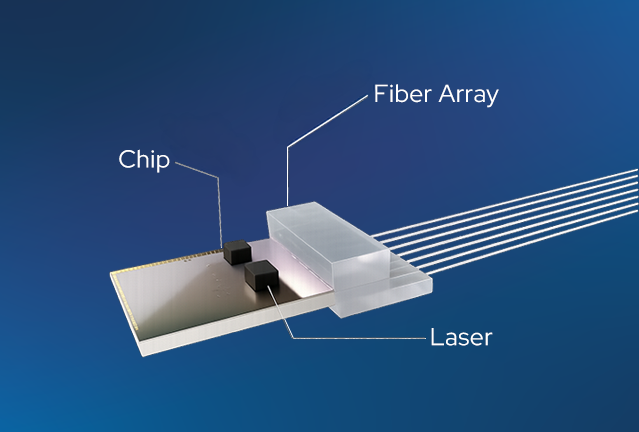
Coupling light into the PIC (Photonics Integrated Circuit) remains one of the most critical challenges in silicon photonics design. At DustPhotonics, we have devised an innovative solution to this problem which we call Low Loss Laser Coupling (L3C). This is a patented technology that enables higher performance and scalability while reducing cost and power consumption.
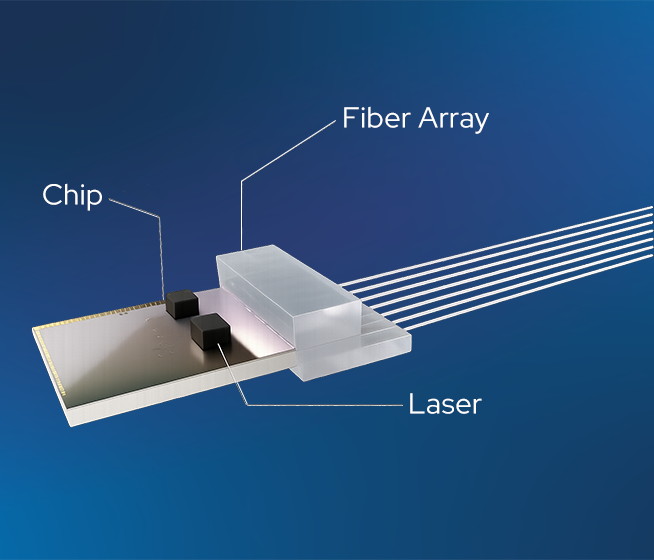
L3C works by integrating off-the-shelf lasers from different manufacturers with the PIC. The benefit to our customers is that it enables a supply chain that is more resilient to constraints, while simplifying production.
Here are some of the most important benefits of L3C.
Higher Coupling Efficiency and Improved Margins to Specifications
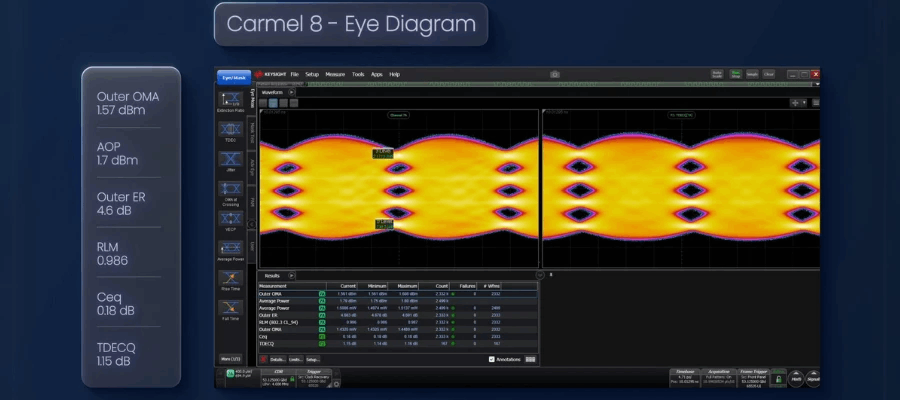
L3C technology enhances the coupling of light into Photonic Integrated Circuits (PICs) by optimizing the interface between lasers and silicon waveguides. Here, we butt-couple the laser to the PIC with sub-micron accuracy using low-cost production equipment. L3C enables higher coupling efficiency, which we can translate into increased optical margins to all the required PIC specifications, including output power, extinction ratio, and TDECQ ( Transmitter and Dispersion Eye Closure Quaternary.) This enables improved product yields, while reducing waste and lowering manufacturing costs.
Lower Overall System Cost
Our short-reach 800G-DR8 product uses a single laser split eight ways for each channel. This approach reduces the need for multiple lasers, which are typically among the most expensive components in optical systems. In addition, leveraging a single laser for multiple channels lowers the parts count, and simplifies the system architecture. The net result is lower manufacturing costs, simpler inventory management, and reduced power consumption overall.
Lower Power Consumption
The reduction in power consumption is another benefit of L3C technology. Our increased coupling efficiency means we can use fewer lasers and/or lower current drive per laser, which allows for lower cooling requirements and, ultimately, more energy-efficient data centers.
Operational Efficiency
By relying on off-the-shelf lasers, L3C boosts operational efficiency, simplified supply chain logistics and rapid production scaling without the costs and complexity of sourcing custom laser components. In addition, specific lasers can be difficult to source during times of peak demand or economic uncertainty. By allowing for a diverse set of interchangeable laser suppliers, L3C also provides supply chain resilience during these times.
Compatibility with Immersion Cooling
Lastly, L3C plays an important role in future-proofing data centers seeking ways to manage thermals as high-performance computing becomes more and more energy intensive. Because our L3C technology eliminates free-space gaps in the TX optical chain, we have made our components compatible with immersion cooling, arguably one of the most promising methods for regulating temperature in high-performance environments.
Low Loss Laser Coupling (L3C): A Key Enabling Technology for Credo
At Credo, we are committed to advancing silicon photonics technology beyond its current limitations. L3C is a key enabling technology for us, and provides numerous benefits for our customers, including: higher coupling efficiency, improved margins to specifications, lower overall system costs, and lower power consumption.