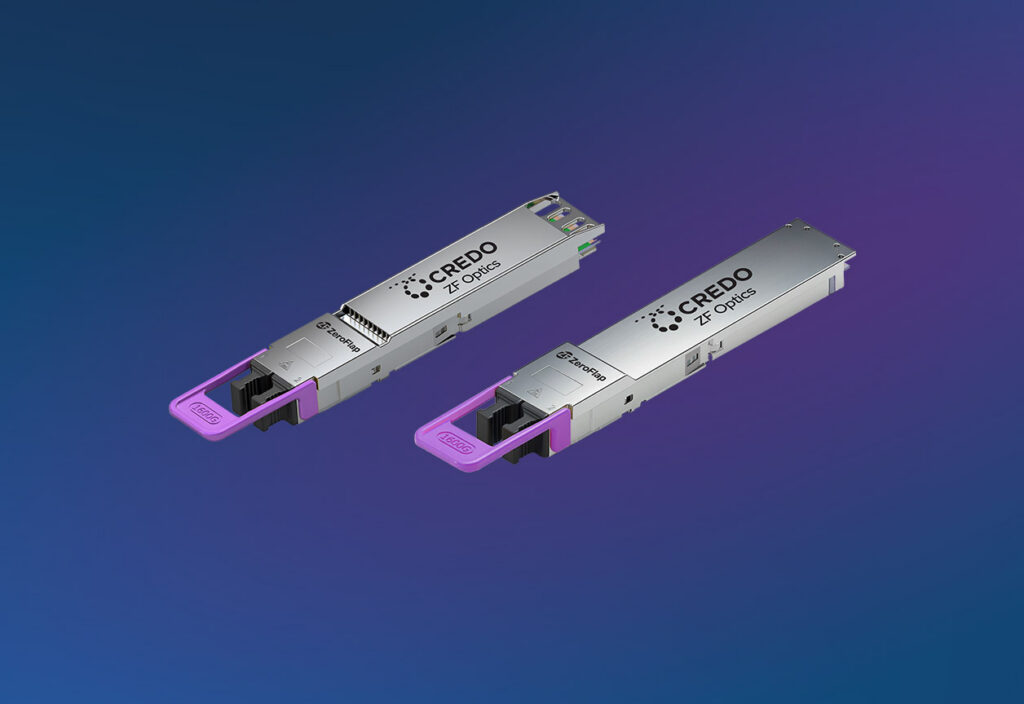
DustPhotonics was acquired by Credo in May 2026. The below article was published on the DustPhotonics website prior to this date.
As AI models grow in complexity and datasets expand, networks must handle ever-increasing bandwidth requirements while minimizing their overall power consumption. This has placed immense pressure on the underlying optical infrastructure, the backbone of high-performance computing and cloud networking.
A Dell’Oro Group report forecasts AI network switch spending will exceed $100B between 2025 and 2029, with most switch ports reaching 800 Gbps by 2025.
These escalating speed requirements amplify the need for scalable, cost-effective manufacturing solutions capable of supporting 200G/lane and beyond.
While Electro-absorption Modulated Lasers (EMLs) have long been a staple in high-speed optical modules, their high costs, supply constraints, and limited scalability are limitations to ongoing growth. Silicon photonics (SiPho) is emerging as a compelling alternative, leveraging standard semiconductor manufacturing processes to produce high-speed optical components at scale. Unlike EMLs, SiPho solutions benefit from the efficiencies of semiconductor foundries, enabling mass production, lower costs, lower power, higher yield and better integration with electronic systems.
As hyperscale data centers and AI clusters continue to push the limits of network capacity, the industry is shifting toward more adaptable, high-volume solutions like silicon photonics.
EMLs in Short Supply: A Catalyst for Change
The shortage of Electro-absorption Modulated Lasers (EMLs) presents a significant supply chain challenge in the optical communications industry, particularly as demand for high-speed connectivity accelerates. EML manufacturing is heavily constrained by the availability of specialty indium phosphide (InP) fabs, which are limited in both number, production capacity, and the challenges of yielding these devices. Inefficiencies in multi-channel assembly and the high costs of EML production further exacerbate these challenges, making it difficult to scale at the rate needed for AI and high-speed networking.
While EMLs have been a dominant choice for ultra-high-speed applications, emerging silicon photonics solutions are closing the gap. SiPho-based transceivers are increasingly capable of supporting 200Gb/s per lanespeeds and are capable of being built in array format with 8 or more channels on a single chip as required.
With these advancements, the ecosystem is diversifying and becoming more resilient, with silicon photonics poised to support the next generation of AI-driven networking.
SiPho vs. EMLs: A Competitive Advantage
Silicon Photonics (SiPho) and Electro-absorption Modulated Lasers (EMLs) are two leading technologies in optical communication, each with its unique strengths and limitations.
Here, we present a balanced comparison, acknowledging the strengths of both technologies to give a comprehensive view.
| Silicon Photonics (SiPho) | Electro-Absorption Modulated Lasers | |
| Scalability | ✅Uses standard semiconductor processes and large production fabs for high-volume manufacturing. | ❌Manual assembly and specialized manufacturing processes. |
| Cost | ✅Cost-effective at scale, with integration reducing production costs. | ❌Higher costs due to complex materials and manufacturing methods. |
| Performance | ❗Strong performance for most applications but higher insertion loss than InP. | ✅Excellent performance in high-speed, long-distance links. Low insertion loss and high signal quality. |
| Power Efficiency | ✅Designed to reduce power consumption in high-density applications. | ❗Generally higher consumption, although the increased power consumption is dwarfed by other components in the transmission system (such as a DSP if used). |
| Time-to-Market | ❌Slow cycle times due to standard semiconductor manufacturing processes. | ✅Quicker turns during development timeframes. |
| Integration | ✅Integrates multiple channels and functions onto a single chip. | ❌Limited integration, often requiring external components. |
| Reliability | ✅ Highly reliable, especially when packaged effectively for robust performance. | ✅Proven reliability in harsh environments and field-proven across many legacy systems. |
| Availability | ✅Flexible supply chain, less vulnerable to shortages. | ❌Prone to shortages due to specialized production requirements. |
Scaling SiPho Manufacturing: Opportunities and Challenges
SiPho is gaining traction, with an increasing number of Tier 1 fabs now offering dedicated SiPho foundry services. This is an indicator of the growing demand for scalable, high-performance optical solutions, positioning SiPho as a key player in the next generation of data infrastructure.
However, challenges remain. While the expansion of SiPho manufacturing capacity helps alleviate supply chain constraints like the ongoing EML shortage, additional issues like PDK (Process Development Kit) maturity, and packaging complexity still need to be addressed.
One promising advancement in this space is DustPhotonics’ Low Loss Laser Coupling (L3C) technology, which streamlines the integration of lasers with Photonic Integrated Circuits (PICs). By eliminating free-space gaps in the TX optical chain, L3C enhances coupling efficiency, reduces power consumption, and simplifies the manufacturing process, helping to mitigate the complexities of packaging SiPho devices at scale.
Despite these hurdles, innovations like L3C are critical in enabling SiPho to scale effectively, balancing market demand and ensuring a more resilient supply chain for the optical networking industry.
Sources:
EML vs. DML: Essential Laser Technologies in 100G/200G/400G/800G Optics
Modulators in Silicon Photonics—Heterogenous Integration & and Beyond