DustPhotonics was acquired by Credo in May 2026. The below article was published on the DustPhotonics website prior to this date.
Optical connectivity in data center and AI infrastructure is evolving as system architects address rising bandwidth requirements and power constraints.
Today, most deployed systems rely on pluggable transceivers mounted at the front panel of switches or servers. As lane speeds increase and overall switch bandwidth scales, the placement of optical engines relative to the ASIC has become a core architectural decision.
Across the industry, three primary architectures are being evaluated:
- Pluggable Optics
- Co-Packaged Optics (CPO)
- Near-Package Optics (NPO)
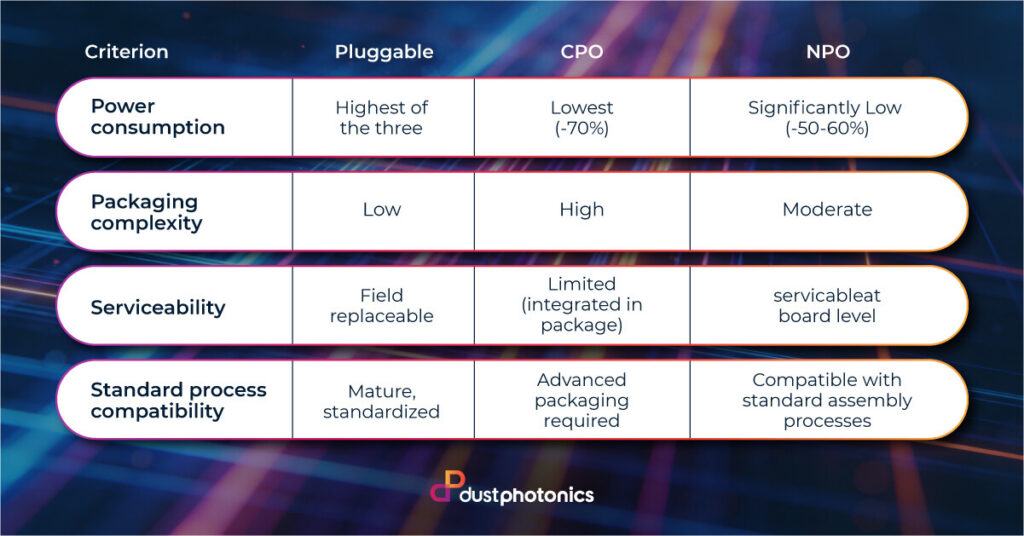
Each presents distinct trade-offs in power, packaging complexity, and serviceability.
Optical Connectivity Architectures
1. Pluggable Optics
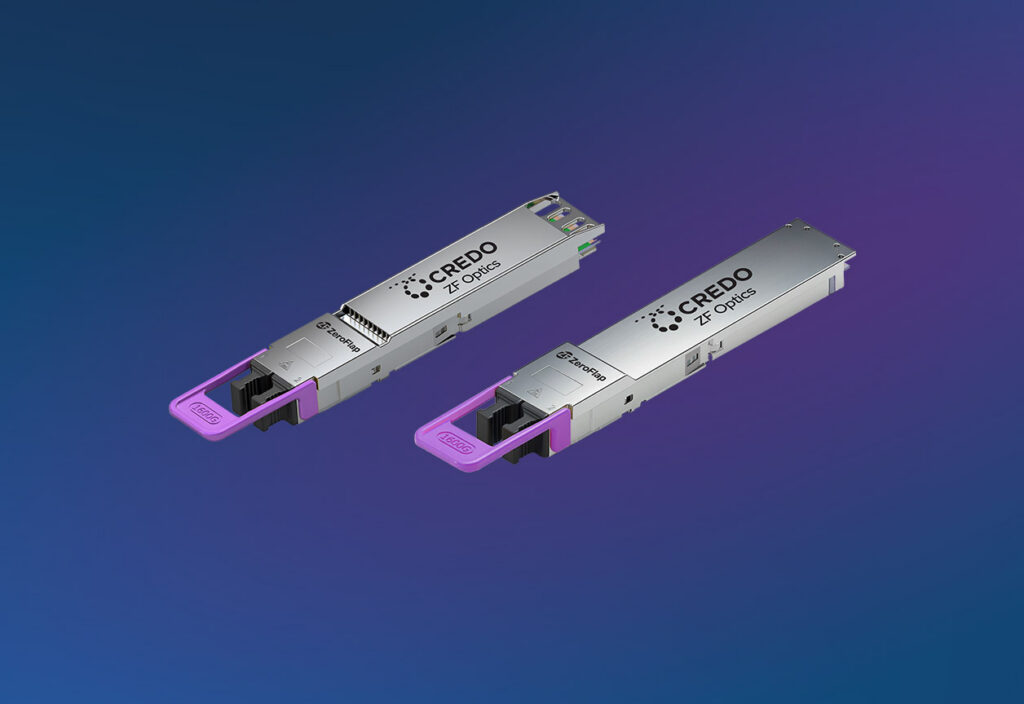
Pluggable optics remain the predominant architecture in deployed systems.
In this approach:
- Optical transceivers are inserted into cages located at the edge of the board
- Electrical signals travel from the switch or GPU across the PCB to the pluggable connector
- Signal conditioning and optical conversion occur inside the pluggable module
This model provides:
- Field serviceability
- Multi-vendor interoperability through standardized form factors
- Mature supply chains
However, because the optical interface sits at the board edge, the electrical path between the ASIC and the module is relatively long. At advanced lane rates, this contributes to higher overall system power.
2. Co-Packaged Optics (CPO)
Co-packaged optics integrate optical engines directly with the switch or compute package.
In this model:
- Optical engines are co-packaged alongside the ASIC
- Optical and electronic components share a common package or substrate
- Electrical distance between compute and optics is minimized
CPO delivers the maximum achievable reduction in electrical path length, which can translate into improved overall power efficiency at the system level.
However, this architecture also comes with:
- High packaging complexity
- Serviceability challenges, since optics are integrated within the ASIC package
3. Near-Package Optics (NPO)
Near-package optics place optical engines on the PCB in close proximity to the switch or GPU package.
In this architecture:
- Optical engines are mounted on the board near the compute device
- Electrical connections between ASIC and optics are short
- Optical fibers exit from near-package modules rather than the board edge
Importantly, NPO has advantages similar to CPO
- Offers significant power reduction
- Uses established PCB assembly and packaging processes
- Supports system-level serviceability
NPO is being evaluated as a practical architectural option that balances efficiency gains with manufacturing and operational considerations.
Architecture Comparison
This comparison highlights the core trade-offs system designers are evaluating as port speeds increase and power budgets tighten.
DustPhotonics and Near-Package Optics
DustPhotonics develops silicon photonics building blocks designed to support multiple deployment architectures, including pluggable, near-package, and co-packaged implementations.
The company’s silicon photonics platforms are designed to integrate optical functions into compact engines that can be deployed in different system placements. Technologies such as Low-Loss Laser Coupling (L3C) enable integrated laser attachment approaches that are compatible with near-package configurations. By integrating laser sources directly with photonic integrated circuits, these approaches can reduce optical coupling loss and simplify system-level implementation compared to external laser source models. This integration supports the small-form-factor optical engines required for near-package optics.
Because the same photonic core can be deployed across architectures, system designers retain flexibility as infrastructure strategies evolve.
Conclusion
Optical connectivity architectures are shifting from traditional pluggable modules toward lower-power integration models.
- Pluggables remain widely deployed and highly serviceable.
- CPO maximizes powerefficiency but increases packaging complexity and limits serviceability.
- NPO offers a balanced approach: reduced power consumption, compatibility with established manufacturing processes, and maintained system serviceability. This is an extension of CPO solutions, but simpler in implementation.
As data center and AI infrastructure continue to scale, these architectural trade-offs will remain central to system design decisions.