< View Blog
OFC 2026 Highlights Critical Role of Reliability and Scalability in AI Infrastructure
Credo debuted its expanded optical portfolio at the 2026 Optical Fiber Communication Conference and Exhibition (OFC) in Los Angeles, highlighting the significant role that high-speed optical connectivity has on enabling next-generation, high-bandwidth, AI-driven infrastructure.


Credo debuted its expanded optical portfolio at the 2026 Optical Fiber Communication Conference and Exhibition (OFC) in Los Angeles, highlighting the significant role that high-speed optical connectivity has on enabling next-generation, high-bandwidth, AI-driven infrastructure.
The company’s demonstrations—spanning 400G and 800G ZeroFlap optical transceivers, 800G and 1.6T optical DSPs, and their role in back-end networks—underscore the importance of scalability, energy‑efficient data movement, and real‑time telemetry for increasingly complex AI scale‑out fabrics.
These innovations showcase how Credo is addressing rapidly growing bandwidth demands while improving signal integrity, power efficiency, and network reliability—key priorities for operators building the next era of high-performance data centers and AI clusters.
ZF Optics Predicts and Prevents Link Flaps: Credo Gives ZeroFlaps
Credo announced general availability of its groundbreaking 800G 2×DR4 ZeroFlap (ZF) transceiver product line, designed to eliminate the persistent connectivity challenges—especially link flaps—that slow AI cluster performance and complicate large-scale deployments. By delivering greater stability and faster fault detection, ZF transceivers help accelerate time to first token and boost overall productivity, creating meaningful operational gains for AI infrastructure.
Credo demonstrated these capabilities in action at its booth at OFC, showing live 400G and 800G ZF transceivers running within an AI network fabric. Utilizing PILOT powered link telemetry, the demo displayed the value of ZF optics in modern AI environments and Credo’s belief that reliability must scale with bandwidth.
Expanded Optical DSP Portfolio for Flexible Deployment Options
Credo introduced its Robin 800 series of DSPs, purpose built for AI optimized 800G transceivers, and offering improved signal integrity, lower power consumption, and flexible deployment options. Robin’s highly compact substrate design reduces PCB space requirements by up to 50% compared with competing solutions, simplifying board layouts, and helping to lower manufacturing costs.
Credo also introduced its second-generation 1.6T optical DSP family, Cardinal. The Cardinal optical DSP family addresses the bandwidth, scale, and power requirements of massive AI clusters with a proven low-power architecture, and superior latency with the flexibility to support both retimed 1.6T optics, and ultraefficient linear receive implementations.
Credo demonstrated its Robin, Cardinal, and Bluebird optical DSPs at its OFC booth. This included a live AI scale-out network demonstration of an 800G backend network featuring Credo optical DSPs powering transceivers from Credo customers. A second demonstration of a 1.6T LRO module based on Credo’s 3nm Bluebird DSP showed high performance, low bit error rate (BER) and exceptional signal quality.
Of course, no tradeshow is complete without our signature purple active electrical cables (AECs). Credo showcased its 1.6T ZeroFlap AECs, designed to power next-gen AI with 3nm DSP technology at 200G/lane. Attendees were also able to view static demos of Credo 1.6T AECs in the next-generation Vera Rubin GPU NVL144 and Kyber Ultra NVL576 platforms.
Technical Conference Program Presentation
“Improved Multi-Path Interference Detection With Calibrated Variance Difference,” presented by Credo’s Likai Zhu during the OFC Technical Conference Program, proposed an improved MPI detection method based on the Calibrated Variance Difference of the modulation levels; the influences of noise and extinction ratio on the MPI indicator are minimized.
Authors of the paper from Credo include Likai Zhu, Principal Optical System Engineer; Junqing Sun, Vice President, Architecture; Nina Krainova, Optical Systems Applications Engineer; and Tianchen Luo, System Design Engineer Director.
OFC technical conference attendees can download the paper at the link here.
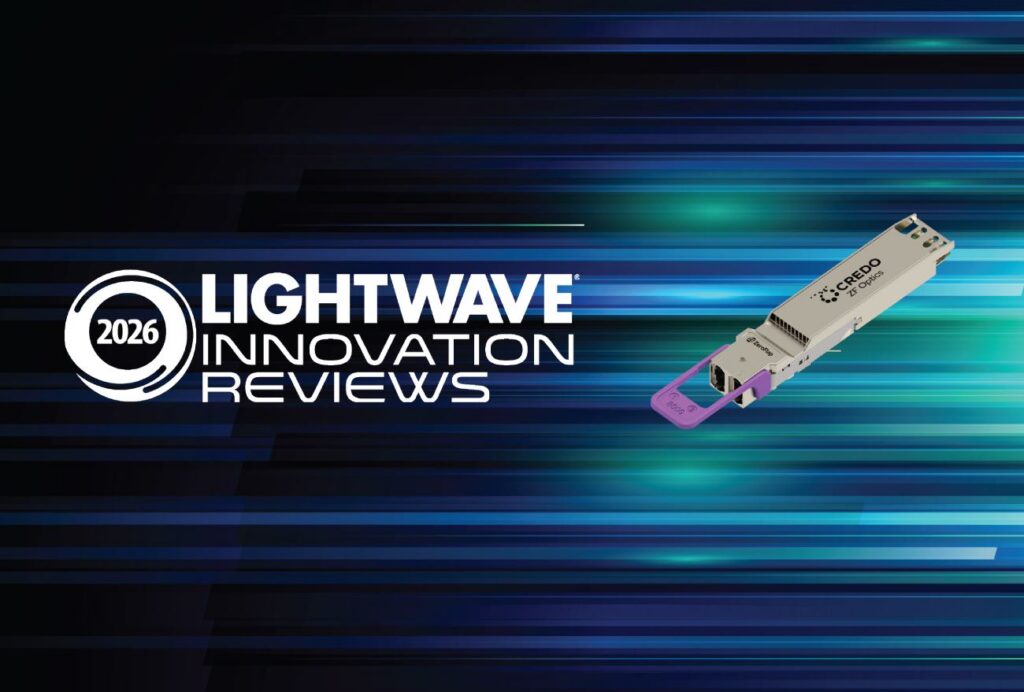
Credo’s ZeroFlap Optical Transceivers Receive 2026 Lightwave Innovation Honors

Credo Partners with Second Harvest of Silicon Valley to Help Address Hunger in the Community