PCIe Gen6 runs at 64 Gigatransfers per second (GT/s) — twice the speed of Gen5 — and it gets there using PAM4 signaling, which packs more data into every electrical pulse. The trade-off is that the signal itself becomes far more fragile. The margin for error shrinks at every point in the link, and details that were once negligible become critical: how heat spreads across a board, small differences in trace lengths, variations between connectors, and even the power swings caused by the workload itself.
In modern AI servers, retimers (chips that clean up and re-launch the signal mid-route) sit at the most fragile points in the data path:
- Between the CPU and accelerator
- Between the CPU and NIC or SSD
- Across multi-hop PCIe fabrics connecting many devices
Instability at these junctions directly affects latency, throughput, and even scheduler behavior. At Gen6 speeds, even minor margin erosion can lead to measurable system variability. A retimer must therefore do more than simply recover eye diagrams; it must maintain margin under dynamic operating conditions.
And here is the part that catches teams off guard: instability rarely begins as a failure. It typically starts with:
- Intermittent recoveries
- Equalization parameter churn
- Temperature-correlated margin drift
- Growing lane-to-lane asymmetry
Without visibility, these patterns remain hidden until events disrupt performance. By the time a link visibly fails, the warning signs have usually been present for a long time — just unobserved.
Credo Toucan PCIe retimers and PILOT are designed to deliver performance and visibility – together.
At 64 GT/s PAM4, PCIe Gen6 links leave little room for error. Channels that look healthy at bring-up can drift as temperatures swing, boards vary, and workloads shift. Credo addresses this challenge on two fronts: Toucan PCIe retimers keep links stable in real time, and PILOT makes that stability visible and measurable. Together, they deliver performance and visibility as a single, engineered system.
Credo Toucan: Stability that adapts continuously
Credo Toucan Gen6 retimers hold stable margin across high-loss channels by continuously adapting to changing conditions. This adaptation happens through:
This adaptive behavior allows links to remain healthy across temperature swings, board variations, and workload transitions.
PILOT: Making electrical margin visible in real time
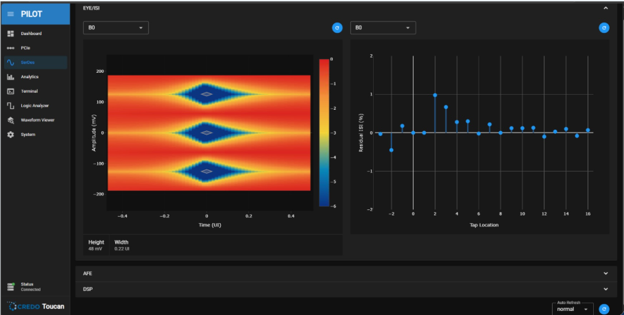
At Gen6 speeds, adaptation alone isn’t enough; stability must also be measurable. That measurement starts at the retimer, where Toucan PCIe surfaces key link health signals:
- Lane-level Figure of Merit (FOM) SNR & BER
- Equalization state (CTLE, VGA, Rx FFE taps)
- LTSSM state transitions
- Recovery event frequency
- On-die temperature and voltage telemetry
PILOT (Predictive Integrity, Link Optimization, and Telemetry) is the software layer that collects this telemetry and organizes it into a coherent view of link health over time, delivering:
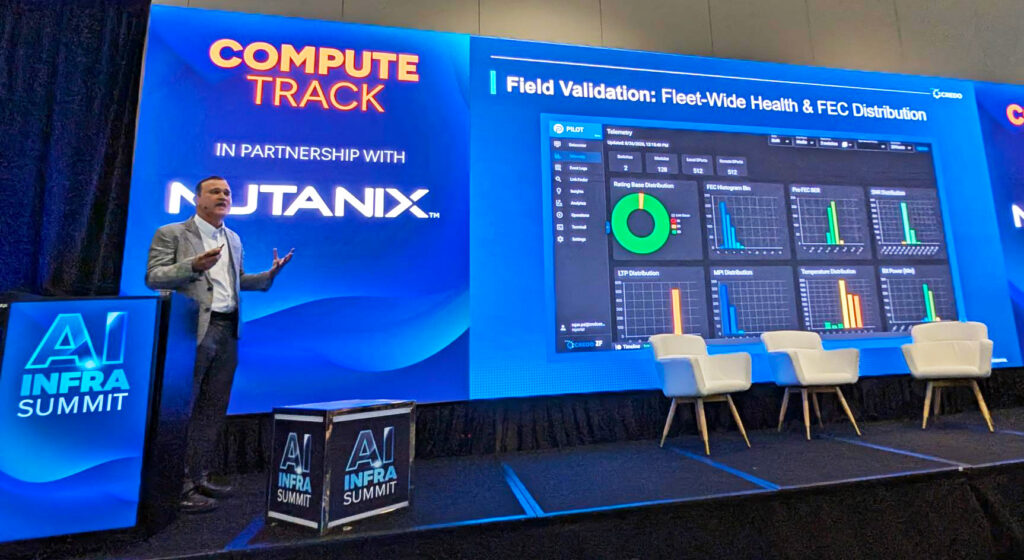
- Real-time link health dashboards
- Eye heatmap visualizations
- Margin trend tracking
- Correlation between link behavior and environmental conditions
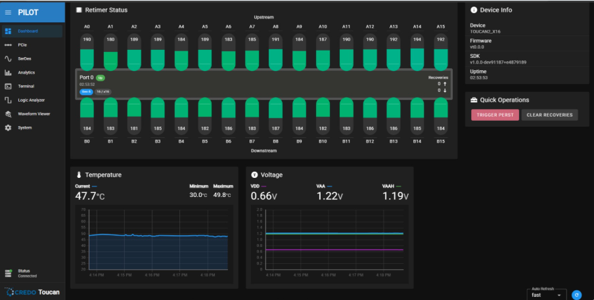
This shifts validation and deployment from reactive troubleshooting to proactive monitoring. Instead of asking: “Why did this link retrain?” system teams can ask: “Which links are trending toward instability under this workload?” That distinction matters at scale.
Why Toucan + PILOT Matters
By combining Toucan’s adaptive retiming with PILOT’s structured observability, system architects gain:
- Early detection of weak links and take preventive measures
- Faster root cause isolation during bring-up
- Improved stability under sustained workload
- Higher sustained throughput
- Greater deployment confidence at scale
Stability is not automatic. It must be engineered and continuously monitored. Toucan PCIe retimers deliver high-performance signal conditioning across challenging channels. PILOT ensures that link behavior is visible, measurable, and actionable over time.
Together, they enable PCIe Gen6 systems that are not only fast but also stable under real-world operating conditions.