DustPhotonics was acquired by Credo in May 2026. The below article was published on the DustPhotonics website prior to this date.
The demand for faster, more efficient data transmission continues to grow, driven by AI clusters and cloud data centers. The racks of compute engines (GPU, CPU and storage) and the accompanying network infrastructure required for these applications consume significant electrical power from the grid. In a power-constrained AI cluster or data center, every Watt of power that is used by the network is a Watt of power that cannot be allocated to compute. As such, minimizing the overall power consumed by the network is key to having the most powerful and efficient AI and data center infrastructure.
Linear Receive Optics (LRO) and Linear Pluggable Optics (LPO) are 2 key solutions that engineers building AI infrastructure are exploring to reduce the power from network equipment. Both of these technologies reduce power consumption and eliminate components in optical modules, which makes them increasingly favored for high-speed AI clusters and data centers.
Here, we are exploring the advantages and challenges of both LRO and LPO, and the pivotal role that silicon photonics is playing in amplifying the performance and cost benefits of both formats.
Architectures of Fully-Retimed vs. LPO vs. LRO Modules
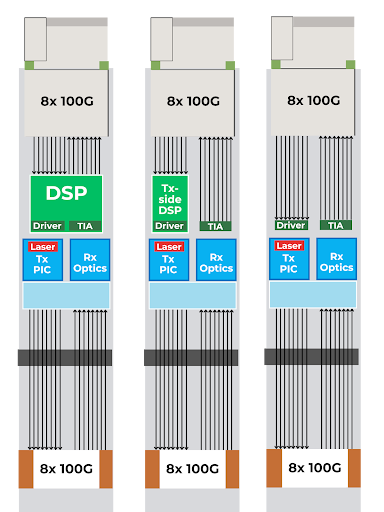
In the Figure 1 below, you’ll note how the optical module architecture changes as we move from a fully-retimed module to an LRO module and to an LPO module.
What is LPO (Linear Pluggable Optics)?
LPO (Linear Pluggable Optics) transceivers lack full retiming (DSP) circuitry that is common in all prior generations of 400G, 800G and 1.6T optical modules. As a result, LPO relies on the host to handle retiming and signal conditioning, unlike traditional fully retimed optical modules. By removing the DSP, LPO reduces power consumption without sacrificing high-speed data transmission, but requires careful engineering to ensure that robust links can be built.
LPO Advantages:
LPO has several advantages, including:
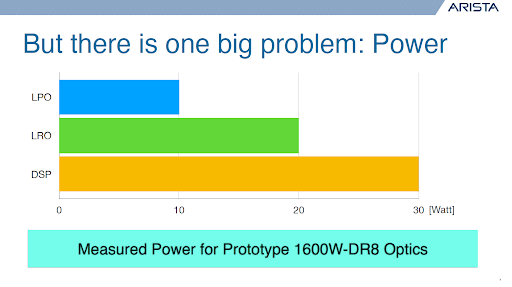
- Lower power consumption: Retimers are energy-intensive, so removing them from the module has a significant impact on power reduction. Figure 2 below shows estimated of the power savings of 1.6T modules in going from fully retimed to LRO to LPO modules.
- Cost efficiency: LPO reduces the module cost by reducing a key BOM element – the DSP – which accounts for over 25% of the BOM cost of a typical module.
LPO Disadvantages:
It is more challenging for an LPO system to close a link with robust signal integrity. The system needs to support a signal link with about 16 dB of loss from the host switch to the module on both the transmit and receive sides, along with several dB of optical loss. The ideal system must also allow for an any-to-any configuration: any LPO module should be able to connect with any LPO switch, and this combination should communicate with an equivalent LPO module and switch on the other end of the link, even if they’re made by different manufacturers. This ideal any-to-any goal will be challenging to achieve at 100G/channel and will be increasingly difficult to achieve at 200G/channel.
2 Possible Solutions: Book-Ended or Engineered Link
If this ideal setup isn’t possible, it may be necessary to fall back on a book-ended solution, using only one specific manufacturer’s hardware on both sides of the link. An alternative is an engineered link: a connection custom designed for a particular setup.
The book-ended solution may be easier to implement, but it limits flexibility and leads to vendor lock-in. This is a major obstacle for interoperability. Engineered links avoid this problem but introduce another: the complexity of customization increases costs, which can make large-scale deployments less feasible.
What is LRO (Linear Receive Optics)?
LRO modules operate with a single DSP on the transmit side, removing the DSP commonly found on the receive side of fully retimed modules. By doing this, LRO provides some power reduction to the overall module while still providing some retiming function in the overall system link.
Just like with LPO, the responsibility for signal recovery shifts to the host system, which must be able to manage signal integrity to ensure optimal performance.
LRO Advantages:
This shift provides several advantages:
- Reduced power draw: LRO modules consume less power compared to fully retimed modules by eliminating the need for retiming on the receive side, but do not offer as much power savings as LPO modules.
- Cost efficiency: The absence of retiming circuitry on the receive side reduces the complexity of the receiver module as compared to a fully retimed module, but similarly, the impact is not as significant as LPO modules.
LRO Disadvantages:
LRO comes with a different set of benefits and drawbacks to its competing solution. In short, LRO represents a compromise solution with about half the power and cost savings as compared to LPO interfaces. Perhaps the biggest advantage of LRO is that it significantly reduces the risk to overall link performance. With a single DSP mid-span between each host, many challenges of interoperability can be eliminated.
Optimizing LRO and LPO for Scale: the Role of Silicon Photonics
Silicon photonics plays a key role in improving both LRO (Linear Receive Optics) and LPO (Linear Pluggable Optics) in several ways:
1. Power Efficiency
Silicon photonics reduces power consumption in both LRO and LPO modules by integrating optical components directly on silicon chips. Traditional optical modules require separate components for signal generation, modulation, and detection, all of which consume power. Silicon photonics allows these components to be miniaturized and combined on a single chip, leading to lower energy use, which is especially important in LPO where power efficiency is a key advantage.
2. Cost Reduction
The use of silicon photonics can lower the cost of producing LRO and LPO modules, because silicon photonics relies on semiconductor fab manufacturing processes. As a result, manufacturers can produce optical modules more cheaply than traditional methods, helping reduce the costs of both LRO and LPO solutions.
3. High-Density Integration
Silicon photonics allows for greater integration of optical and electrical components on a single chip, leading to more compact and scalable LRO and LPO modules. This is particularly beneficial for LPO, where simplifying the transceiver design is a major goal. This integration enables the development of smaller, and more efficient transceivers that can still handle high data rates without requiring external retiming circuitry within the module.
4. Increased Linearity
The increased linearity of silicon photonics modulators, exemplified by advancements in Mach-Zehnder Modulator (MZM) technology, ensures a more proportional output signal, reducing distortion and enhancing signal integrity. These advancements make silicon photonics a better alternative for Linear Pluggable Optics (LPO) due to their low power consumption, high integration with existing CMOS technology, and overall high performance. The result is more efficient and reliable optical communication networks.
5. Availability at 200G/channel
LRO solutions are expected to be lower risk for cable applications, like Active Optical Cables (AOCs), where the entire fiber infrastructure and both transceiver ends ship together as one integral solution, which essentially creates a defacto book-ended solution. These AOC products have historically been served by VCSELs, however, VCSELs at 200G/channel are not available, and there is no definitive timeframe for when they will be available. As such, silicon photonics is well positioned to replace VCSELs in this AOC application, as well as VCSELs that are used for transceivers.
How does silicon photonics improve high-speed data transmission?
As AI clusters push traditional infrastructure to its limits, minimizing latency and power consumption is critical. Silicon photonics improves high-speed data transmission by multiplexing multiple laser wavelengths onto a single fiber and minimizing signal degradation.
In advanced architectures utilizing copackaged optics, bringing the cpo optical engine closer to the compute switch drastically cuts down the electrical trace length.
How do photonic devices differ from traditional electronic devices in this scenario? Instead of pushing electrical signals over lossy copper across a board, photonic systems transmit data via light, resulting in faster throughput, improved signal integrity, and significantly lower power requirements.
DustPhotonics: Bridging the Gap Between Performance and Energy Efficiency
Optical networks face a delicate balance: maximizing performance while managing energy use. As data centers increasingly explore options like LRO and LPO to align these priorities, the adoption of silicon photonics continues to gain traction. DustPhotonics is prepared to support this evolution, advancing scalable, efficient solutions that meet the growing demands of the industry. Partner with us to explore the potential of silicon photonics for your optical needs.