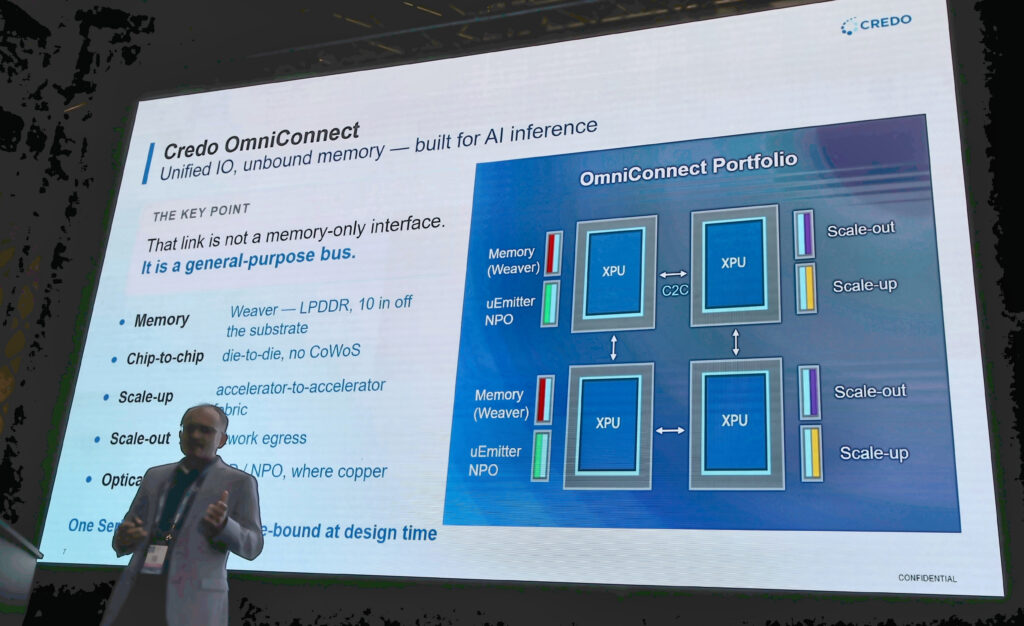
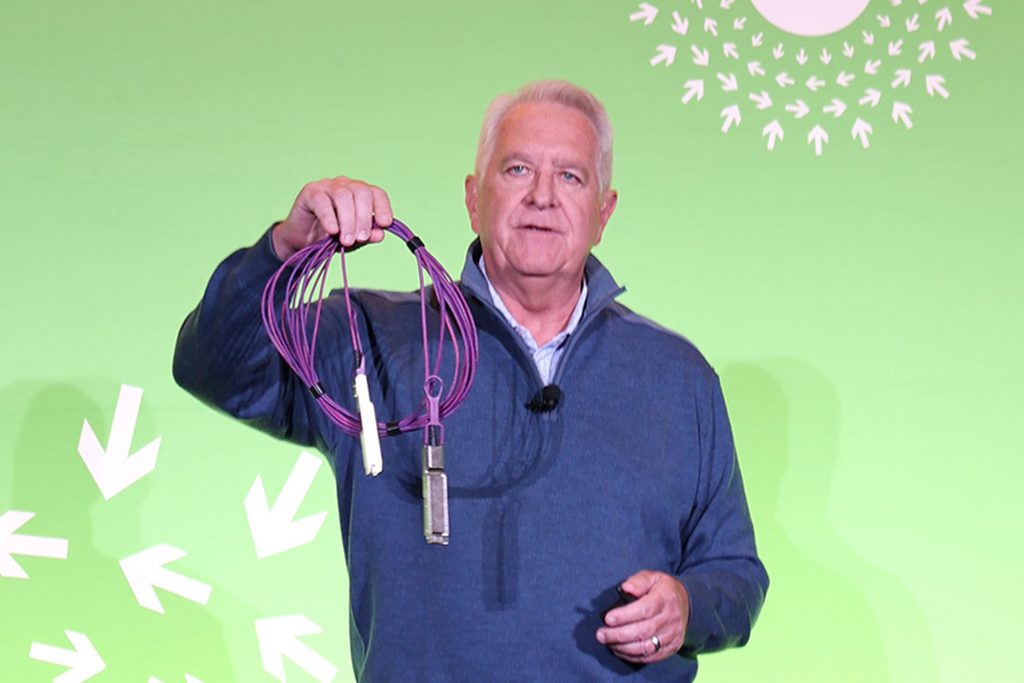
Credo President and CEO Bill Brennan announced the 1.6T ZeroFlap Active Light Cable and the Short-Reach Micro-Emitter Optics Workstream during Day 1 of OCP Global Summit 2026 in San Jose.
As clusters scale from thousands to tens of thousands of accelerators, the links between them have to move more data, more reliably, without burning through the power budget. Copper and optics each have a role to play — the trouble has been one critical distance range, right in the middle, that hasn’t had a great option until now.
During the OCP Global Summit, Credo introduced its commitment to a different way to close that gap: micro-emitter optics. It’s the subject of three announcements from our team within a week — a technical presentation from our CEO to outline the vision, the launch of our first micro-emitter-based product — the 1.6T ZeroFlap Active Light Cable (ALC), and the announcement of a Short-Reach Micro-Emitter Optics (SRMO) Workstream within the OCP Community to standardize the approach. With so much going on, we feel it’s worth explaining why we think it’s the right foundation of AI networking for the next decade and beyond.
“‘Wider, slower, better’ is the theme, and it plays directly to the North Star we’ve been following for our customers — better reliability, better power,” Credo President and CEO Bill Brennan told a standing-room-only crowd at the summit. “And by the way, we’ve got the cost down now, too.”


Watch the talk in full on YouTube.
Three Ranges, Three Different Tools
Every data center link has to solve the same basic equation: move more data, reliably, without spending more power or money than it has to. There’s no single “best” way to do that — the right technology depends on how far the signal has to travel.
Copper remains the right choice at very short range. It’s passive, inexpensive, and extremely reliable: Credo’s own ZeroFlap active electrical cables (AECs) target 100 million hours mean time between failures (MTBF) at under $0.10 per gigabit per second.
Traditional optics earn their place at the other end of the spectrum: long stretches where copper simply cannot reach. The approach there has been to push a handful of channels as hard as physics allows, leaning on increasingly sophisticated signal processing to keep the data clean at those speeds. That complexity and power draw is the cost of admission for serious distance — and over genuinely long links, it’s a cost worth paying.
The trouble is the stretch in between. As AI clusters have grown — racks within a row, rows within a cluster — more and more connections now fall into a middle distance: too far for copper, but nowhere near far enough to justify the power and cost that traditional optics carry for true long-haul reach.
Micro-emitter technology was built to close that gap. Rather than pushing a few optical channels to extreme data rates, many micro-emitters operate in parallel at optimal individual speeds. A 200G lane, for example, gets split into many low-rate optical channels using simple NRZ modulation — no complex DSP-based signal processing required. It’s a shift from fast-and-narrow to slow-and-wide, purpose-built for the up-to-50m range where neither copper nor traditional optics has ever been the ideal fit.
How it Works
That shift pays off in several ways. Simpler, slower channels need simpler, lower-power circuits. Because channels are now cheap enough to add more of, a link can build in spares — true Layer Zero redundancy, with hitless failover if any individual channel falters. And because emitters sit in a two-dimensional grid rather than a single row along a chip’s edge, far more channels fit into the same footprint.
Why it Matters
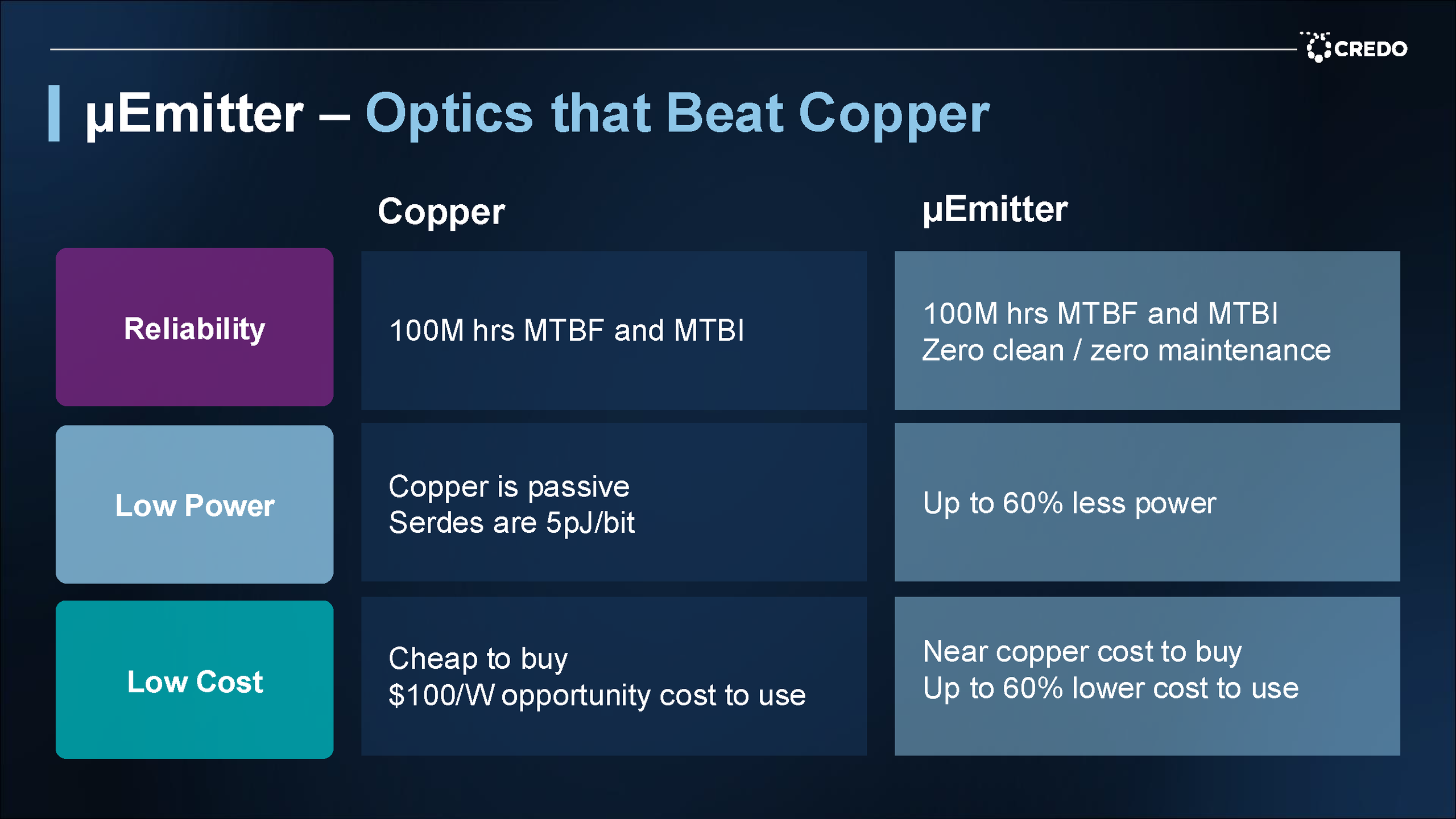
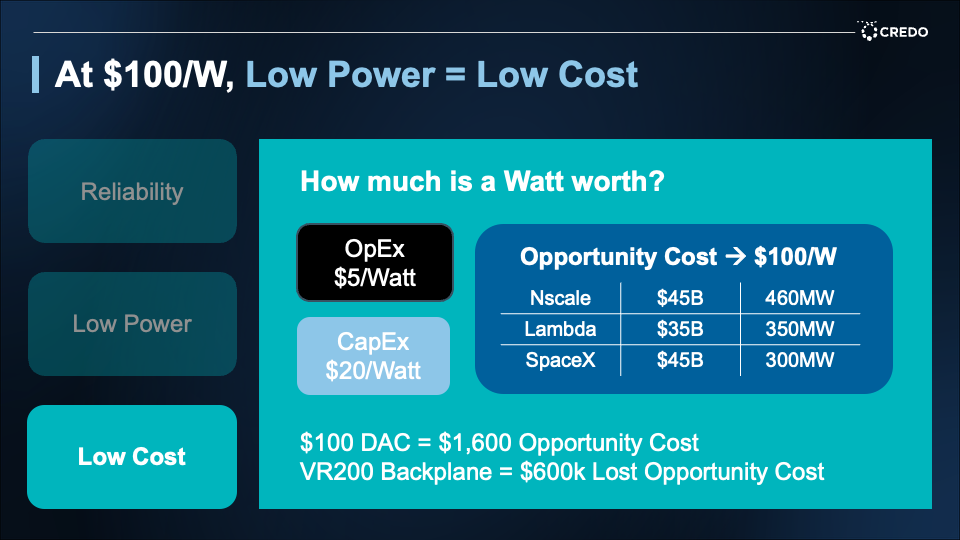
The numbers make the case plainly. Compared to copper, micro-emitter optics hold the same copper-level reliability — a target of 100 million hours MTBF— while adding zero-clean, zero-maintenance operation. The power savings are substantial. A VR200 NV72 copper backplane moves 1Pb/s while drawing about 10kW — roughly 5% of the rack’s total power. Micro-emitters cut that cost by dropping from ~5pJ/bit copper SerDes to under 2pJ/bit, a 60% reduction that saves about 6kW per rack, or 80W per GPU. At today’s infrastructure economics, where a watt saved can be worth $100 or more in opportunity cost once we account for CapEx, OpEx, and the revenue a freed-up watt could otherwise generate, that’s not a rounding error — it’s real capacity.
“Compared to passive copper, this is the lowest baseline power you can talk about — and micro-emitters give us 60% lower power, or even more as we push further,” said Bill during his address. “And because it’s optical, it can go 50m, versus about 1.5m for an AEC. That’s 80W saved per GPU, and 6kW saved per rack.”
And it extends copper-class reliability out to 50 meters — covering the row-scale and rack-scale distances where AI clusters most need to connect, without asking traditional optics to do a job they were never optimized for.
Scale-Out Today. Scale-Up Tomorrow.
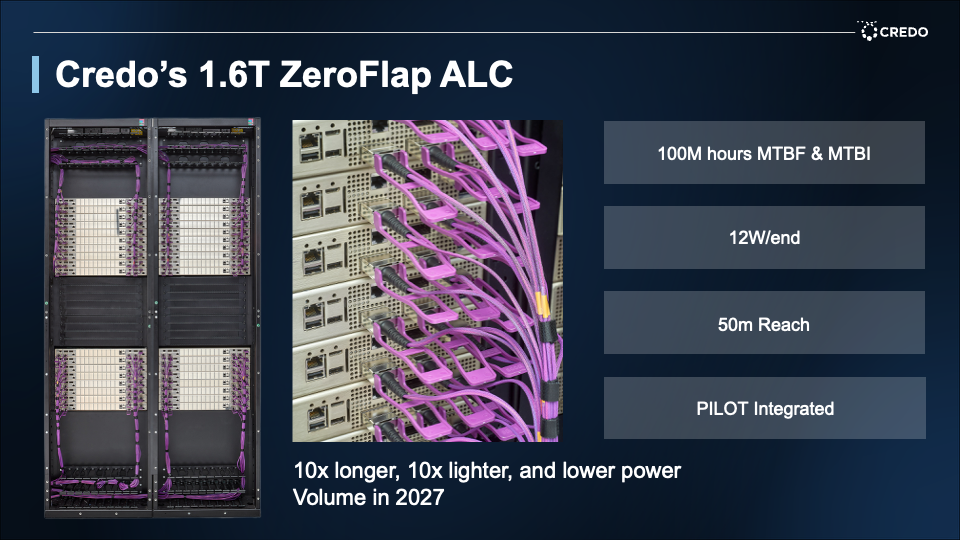
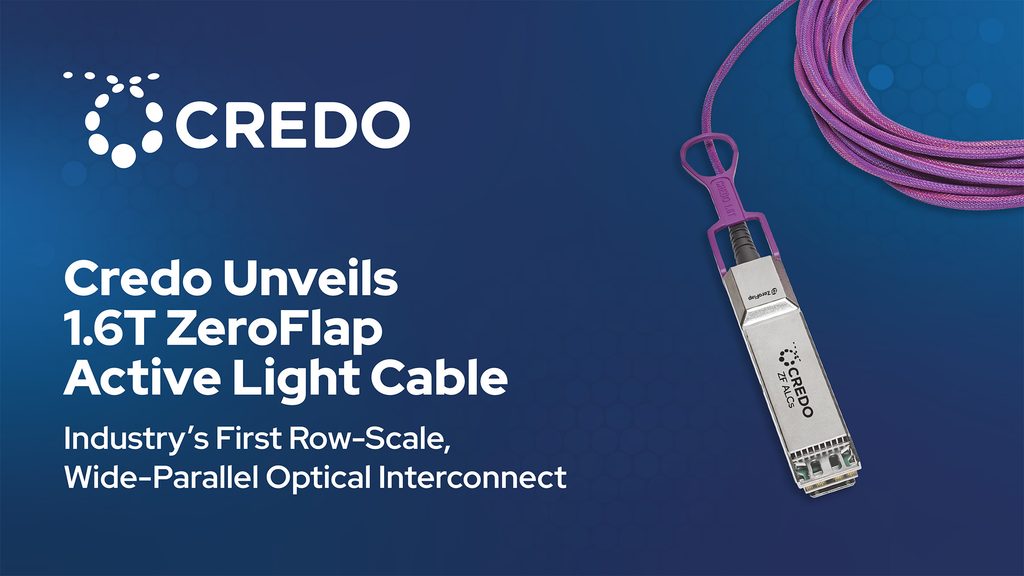
The 1.6T ZeroFlap Active Light Cable (ALC) we announced at the OCP Global Summit brings micro-emitter optics to scale-out networks. It’s the industry’s first pluggable cable to bring wide-parallel, micro-emitter optics to row-scale reach, drawing under 12W per cable end — about 30% less than a comparable active electrical cable — while extending reach to 50 meters and weighing 10x less than an AEC. Built-in channel redundancy and ZeroFlap link monitoring deliver hitless failover with a target of 100 million hours MTBF. It’s shipping in 2027.
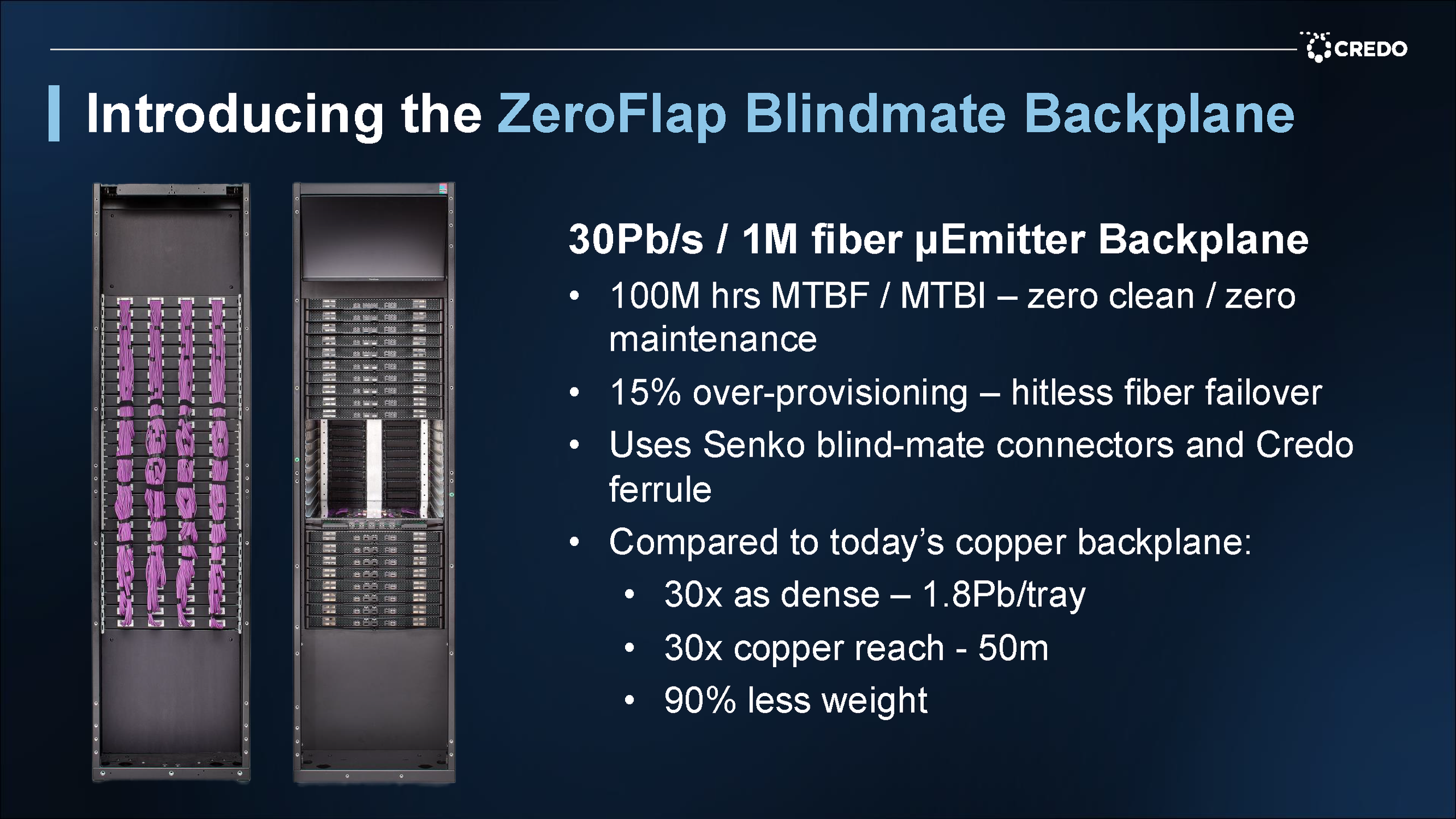
And we’re extending the same architecture to scale-up connectivity. Built in collaboration with SENKO, a new ZeroFlap Blindmate Optical Backplane showcased at the Credo show booth moves 30 petabits per second across a million fibers, with 15% over-provisioning built in for hitless fiber failover. Compared to today’s copper backplanes, it shows 30x the density, 30x the reach, and 90% less weight — proof that the same wide-parallel, redundancy-first architecture that works in a cable, scales just as well onto a board.
Both applications point toward a single architecture we expect to carry us beyond the next decade — scaling from today’s 1.6T ALC and 6.4T near-package optics (NPO), to 3.2T ALC and co-packaged optics (CPO) beyond 5Tb/mm in 2028–29, and eventually to petabit-scale, chip-to-chip scale-in connectivity by 2030 and beyond, as emitters get faster and pitches get tighter.
“When you think about a $100 DAC with SerDes burning 16W, that’s an opportunity cost of about $1,600,” Brennan said. “Now look at what micro-emitters do on something like our backplane: a 60% power reduction there equates to $600,000 in value.”
Why We’re Leading the Push to Standardize it
A new approach to connectivity is only as useful as the ecosystem that can build on it. That’s why, in addition to the product launch, Credo also announced the Short-Reach Micro-Emitter Optics (SRMO) Workstream — a new effort within the Open Compute Project to define an open specification for wide, parallel micro-emitter interconnects, covering link power, efficiency, signaling, parallelism, and physical form factors like module and connector footprint.
We’re launching it alongside a leading hyperscaler and optical technology partners spanning the full connectivity stack — AFL, ams OSRAM, BizLink, Foxlink, Heraeus Covantics, SENKO, and YOFC — with a specification targeted for OCP approval in 2027.
L.K. Bhupathi, Credo’s AVP of Product, put it this way: “As AI workloads scale from thousands to tens of thousands of accelerators, the industry needs a standardized approach to wide, parallel optical connectivity — not a patchwork of components that do not fit together or interoperate.”
Partners agree: SENKO’s Obie Roy noted that “realizing the power and density benefits of a micro-emitter approach depends on getting the physical connector interface exactly right,” while ams OSRAM’s Ashkan Seyedi called the workstream “an important part of our strategy to bring the benefits of reliability, efficiency, and simplicity to connectivity in the AI data center.”
See it for Yourself
Want the short version? Watch our video introducing micro-emitter optics, and visit the ZeroFlap ALC product page on our website — or reach out to sales@credosemi.com to talk through where micro-emitters might fit into your own infrastructure.


Micro-Emitters Explained:
Credo AVP of Product LK Bhupathi introduces ZeroFlap ALC with micro-emitter optics. The wide-parallel approach spreads data across many small, low-power channels, building in redundancy, using far less power, and leaving plenty of headroom to scale.